
Analyzing Bank Tangible Book Value
Understanding the anchor of bank valuation

Tangible Book Value (TBV) may be meaningless for many non-financial firms, but it is a useful metric for financial firms—especially banks. Bank assets and liabilities are typically financial instruments with well-defined cash flows that are mostly marked-to-market. Therefore, the balance sheet net worth is a fairly accurate measure of a bank’s value at point in time.
This article is first of a two-part series on analyzing a bank’s TBV and the multiple a market places on it.
TBVPS as a Valuation Anchor
Since balance sheet net worth is typically a fair proxy for bank shareholder value, TBV can be thought of as an “anchor” for a bank’s valuation. Trading opportunities arise any time a bank’s share price diverges from its book value, especially during broader market sell-offs.
If you have conviction in a bank’s ability to navigate difficult environments, understanding where a bank’s value is anchored and what could cause TBV to improve or worsen will give you the confidence to hang on while their stock is being unfairly punished.
However, banks are in the business of maturity transformation—borrowing short-term, lending long-term—which is inherently fragile due to the potential mismatches in asset and liability durations. Bank equity is the first to absorb any hits due to unexpected credit or fair value losses. Book value can be wiped out fairly quickly if bank management makes a few bad decisions.
Understanding the Market Premium (Discount) on a Bank’s Book Value
While you may be confident in a bank’s future prospects, it is important to understand the market’s view. This can be interpreted from the multiple the market puts on a bank’s book value. Price-to-book ratios (PBRs) ultimately tell us whether the market believes a bank is going to create or destroy shareholder value over time.
Each of the three banks from our case studies are trading at depressed PBRs relative to recent history.
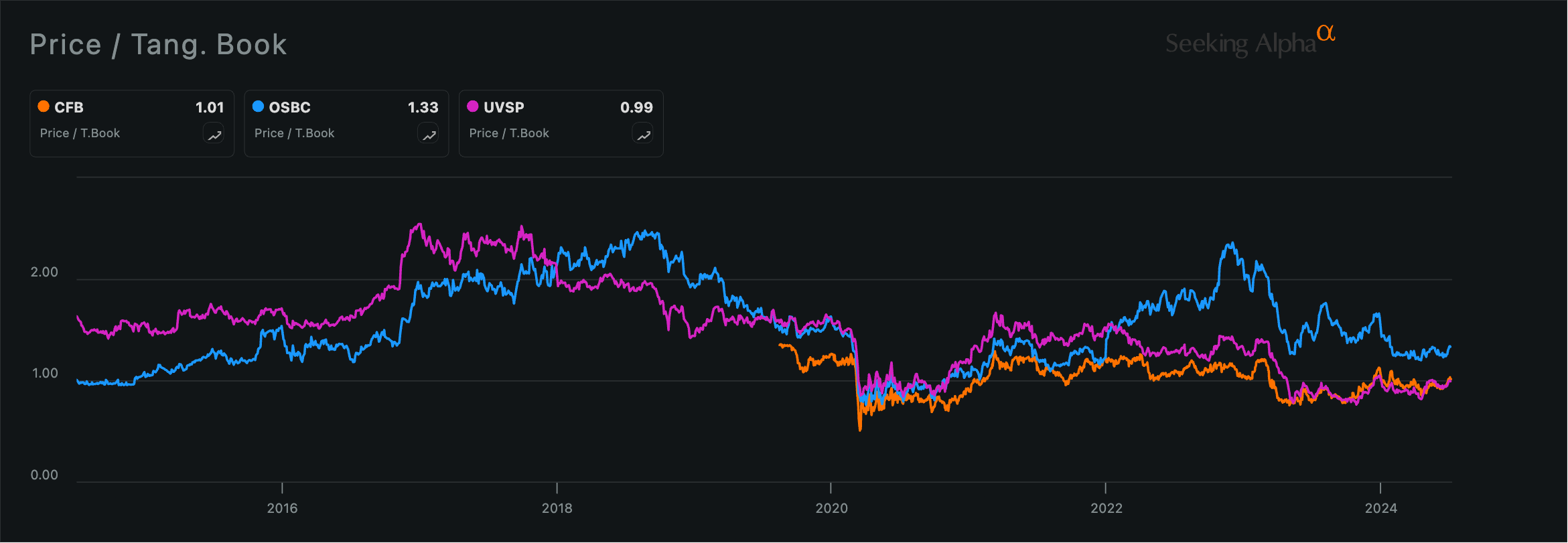
This brings up three questions:
Why are multiples stuck around 1x today?
Should we expect multiples to revert to historical levels?
Why did they trade at a premium in the first place?
The first two questions are simple. Investors are not eager to buy small community banks with significant commercial real estate (CRE) exposure in this current environment. As uncertainty around Fed interest rate policy and CRE headwinds abates, banks that successfully navigated this environment will likely receive a bid and revert to previous multiples. However, maybe the SVB crisis has investors questioning the long-term prospects of all but the largest, systemically important banks?
What drives P/B ratios?
As for why our banks traded at a premium to book value in the first place, it would be helpful to understand what has historically driven PBRs.
In general, this Bank for International Settlements (BIS) study from 2018 finds there were four statistically significant drivers for a bank’s PBRs:
Return on Equity (ROE)
Non-Performing Loans (NPLs)
Non-interest expenses
Dividends
Naturally, ROE is the most significant driver. Investors will pay a premium for consistently strong and growing earnings. Robust earnings also mean a reliable dividend as well, which investors are also willing to pay up for.
NPLs were the second most significant driver. Any signs of credit trouble are going to spook investors, especially in times like these. A bank that maintains an appropriate level of NPLs will be rewarded. Also, after controlling for NPLs, higher provisioning levels are viewed positively by investors “as they seem to value attempts by banks to address asset quality issues in a proactive fashion”.
Higher non-interest expenses will also depress P/B ratios. Declining efficiency ratios (proportion of non-interest expense to operating revenues) and other signals of management’s commitment to cost reductions should be watched closely.
Another interesting development is that investors changed their perspective on balance sheet leverage post-GFC. Instead of seeing leverage as a way to boost ROE, investors are more worried that extensive leverage may threaten solvency.
Conclusion
Now we understand that monitoring Tangible Book Value is crucial for evaluating banks. Additionally, we have an idea of what drives price multiples to book value, along with how we may interpret multiples to determine if bank stocks may be over- or under-valued.
Building on this foundation, next week’s article will take a closer look at Univest, Old Second Bank, and CrossFirst Bank to better understand their book value fluctuations and what the market expects from them.